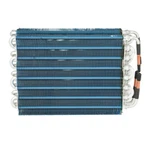
The evaporator, as a crucial piece of equipment for achieving the heat absorption and vaporization of liquid media, operates on a process flow centered on phase change heat transfer. This process encompasses feeding, heating and evaporation, vapor-liquid separation, condensation and recovery, and residual liquid discharge. Each step is closely interconnected to ensure efficient and stable heat energy conversion and material separation.
The process begins at the feeding unit. Before being pumped to the evaporator, the liquid to be processed typically undergoes preheating and filtration to adjust the initial temperature and remove impurities, preventing particulate matter deposition that could affect the heat transfer surface. Precise control of the feed rate and concentration is essential for ensuring evaporation intensity and product quality.
Then, the heating and evaporation stage begins. Within the evaporator, the liquid media exchanges heat with the heating medium (such as steam, hot water, or heat transfer oil), absorbing latent heat and transforming into a gaseous phase under set pressure and temperature. Depending on process requirements, different evaporation methods can be selected, such as falling film, rising film, or forced circulation: Falling film evaporation relies on gravity to ensure a uniform downward flow of the liquid film, suitable for heat-sensitive materials; rising film evaporation utilizes rising steam to drive the liquid film to boil, resulting in high heat transfer efficiency; forced circulation uses a pump to drive the medium to flow at high speed, preventing scaling and adapting to high-viscosity liquids.
The gas-liquid mixture produced by evaporation enters the gas-liquid separation unit. Here, using centrifugal force or inertial separation principles, incompletely evaporated droplets are retained and returned to the evaporation zone, while pure steam is discharged for subsequent processes. Separation efficiency directly affects product concentration and heat energy utilization.
The steam typically enters a condenser to convert into a liquid phase. The recovered condensate can be reused or used as a preheating heat source, achieving energy cascade utilization. Unevaporated concentrated residue is discharged along a set path for further treatment or resource utilization.
The entire process must operate under the monitoring of an automated control system, adjusting parameters such as temperature, pressure, and flow rate in real time to ensure stable evaporation intensity and product quality. A scientifically designed evaporator process can not only improve energy efficiency but also reduce the risk of scaling and corrosion, providing reliable separation and concentration solutions for industries such as chemical, food, and pharmaceutical.