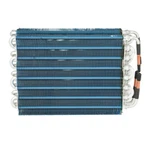
As the core equipment of a heat exchange system, the condenser's characteristics are concentrated in several aspects, including high-efficiency heat transfer, diverse adaptability, reliable operation, and environmental friendliness. These characteristics make it irreplaceable in many fields such as refrigeration, power, chemical, and HVAC.
The primary feature is its high efficiency in heat transfer. The condenser drives heat transfer through the temperature difference between the cooling medium and the high-temperature gaseous working fluid, causing the working fluid to undergo a phase change and condense, releasing a large amount of latent heat. Its heat transfer process relies on optimized heat transfer surface structures, such as finned tubes, reinforced tubes, and extended surfaces, which can significantly improve the heat transfer coefficient per unit area, thereby achieving high-power heat dissipation within a limited space. Different structural forms can be specifically enhanced in shell-side, tube-side, or direct-contact layouts according to operating conditions, balancing heat transfer efficiency and flow resistance control.
Secondly, it offers a variety of types and strong adaptability. Condensers can be categorized by cooling medium into water-cooled, air-cooled, evaporative-cooled, and direct-contact types. They can also be classified by structure into shell-and-tube, coaxial, plate, and spiral types. Water-cooled condensers offer high heat exchange efficiency and a compact structure, suitable for continuous operation under heavy loads. Air-cooled condensers require no water source and offer flexible installation, making them suitable for water-scarce or mobile applications. Evaporative-cooled condensers combine the advantages of water and air, resulting in outstanding energy efficiency. Direct-contact condensers have a simple structure and rapid heat transfer, making them suitable for specific chemical processes. This variety allows for flexible selection based on local resources, environmental conditions, and process requirements.
Furthermore, operational reliability and durability are crucial. Condensers often operate for extended periods under high temperatures, pressures, and conditions potentially involving corrosion or scaling. Therefore, material selection and manufacturing emphasize pressure resistance, heat resistance, and corrosion resistance. Copper alloys, stainless steel, titanium, or special steels are commonly used, supplemented by reasonable tube sheet fixing, expansion joints, or welded sealing structures to ensure tight media isolation and structural stability. Comprehensive support and vibration damping designs can withstand thermal expansion and mechanical vibration, extending service life.
Environmental friendliness and energy efficiency are also significant features. Modern condenser designs prioritize reducing condensing temperature and pressure drop to decrease power consumption of compressors or circulating pumps. In waste heat recovery systems, previously lost heat can be captured and utilized, improving primary energy efficiency. Evaporative cooling and high-efficiency air-cooling structures offer significant water-saving advantages, meeting the green development needs of water-scarce regions. Simultaneously, low-leakage, low-emission sealing and purification designs help reduce the release of harmful substances, meeting increasingly stringent environmental regulations.
Furthermore, ease of maintenance is a crucial consideration in engineering applications. Most condensers are equipped with removable end caps, cleaning ports, and online monitoring interfaces, facilitating regular checks of heat transfer surface cleanliness, component replacement, and troubleshooting, minimizing downtime losses.
Overall, condensers, characterized by high-efficiency heat transfer, diverse types, reliable operation, energy saving and environmental protection, and ease of maintenance, not only meet the thermal management needs of various industrial and civil applications but also provide solid technical support for improving overall system energy efficiency and sustainability.